

What Is The Function Of A Computers Register
Introduction to Register Memory
The smallest and fastest memory in a computer that is non part of the main memory is called Register Memory. This retentivity is located in CPU every bit registers where registers tin exist identified as the smallest elements to hold information. Frequently used data is stored in registers as well as the instructions and the retentivity accost used in CPU. Data or address is given to the CPU where the data is stored and retrieved. Register retentivity also has the location of the data so that accessing data is easy from the CPU or from the register.
Architecture of Register Retentiveness
- This is an architecture that is led past instructions and so that operations are performed on the memory and the registers. If the compages has all the operands in the register, then it is called as register plus retention architecture.
- One of the operands of an functioning tin can be in the memory and the other one in the register. This acts equally a difference from other architectures where both operands of operation should exist either in the register or in the retentivity.
- Examples are IBM System/360 and Intel x86.
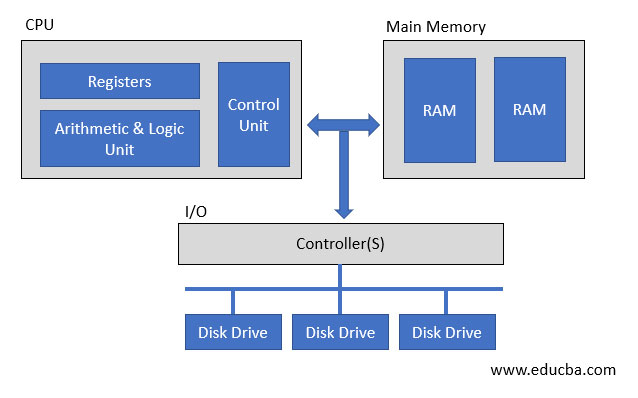
- Registers are pocket-size in size and the numbers are also less in CPU. The size of a annals is less than 64 bits. It is faster than the primary retentiveness and deejay memory. The discussion size depends on the size of general-purpose registers.
- Instructions are given from the computer for the registration number and the addresses in the register. Unlike identifiers of registers include R0, R1, R7, SP, and PC. Register acts as an interface between programme and data storage in the organisation.
Blazon and Function of Register Retention
The three important functions of computer registers are fetching, decoding, and execution. Data instructions from the user are collected and stored in the specific location by the register. The instructions are interpreted and processed so that the desired output is given to the user. The information has to be fully processed and then that the user gets and understands the results as expected. The tasks are interpreted past the registers and stored in calculator memory. When a user asks for the same, information technology is given to the user. The processing is done co-ordinate to the demand of the user.
Different registers are used in the computer arrangement to store data and to help in memory usage. There are specific functions for all the registers used in CPU. Common annals types are explained below.
- Memory Address Register: This register holds the addresses and instructions. Stored data and instructions can be accessed using this register from the memory and then that instructions can be executed finer.
- Memory Buffer Register: Contents inside data or the given instructions are held in this register that is either read or stored in the CPU. The instructions in this register are moved to the instruction register and the data stored here is moved to the input-output register.
- Didactics Register: All the instructions from the main memory is stored in this annals. The Control unit of measurement handles the instructions from this register. Interprets and compiles it. This is done with the aid of sensitive signals so that assigned tasks are carried out.
- Program Counter Register: This is as well chosen the instruction pointer register. The accost of the instructions are saved here. Also, the locations are sorted out so that the IP address is known. This register has the address of all the instructions in the memory or CPU.
- Accumulator Annals: The register located inside the Arithmetic Logic Unit and helps in arithmetics and logic operations of the system is called Accumulator Register. Information values of these operations are fetched from CPU and stored in specific locations of the register and fetched whenever required. Previous information, immediate results, and last results are held in this register. The last result is given to the user with the assist of the Memory Buffer Register.
- Stack Control Register: Gear up of retentiveness blocks is chosen stack. Data stored and retrieved from the blocks are used for operations and the retrieval is in a systematic mode. Its guild is in the form of First In Last Out (FILO). The stacks are managed in the CPU memory and the size is ordinarily in the range of 2-four bytes.
- Flag Register: Occurrence of the certain conditions during operations in CPU is indicated with the help of this annals. The size ranges from i-2 bytes and each bit has a flag or an alarm and if a specific condition occurs, instructions are carried out that is stored in the bit.
Use of Register Memory
- Often used, information, instructions, and the address and location of all these are held in the registers so that CPU can fetch information technology whenever needed. CPU processing instructions are held in the annals. Any data to be processed should pass through the registers before processing. Hence, we can say that registers are used to enter the information past the users to exist candy from the CPU.
- Data is quickly accepted, stored, and transferred in the registers and any type of register is used to perform the specific functions required by CPU. Users need non know much nigh the register every bit it is held past CPU for buffering information and as temporary memory.
- Registers are buffers to store data that is copied from the main retention and then that processor can fetch the data whenever it is needed. The information is held in the register so that the location and address is known to the annals and can be used to know the IP addresses.
- The base annals tin alter reckoner operations or the operands according to the need and address portion can be added to the register in the instruction of the computer system.
Any CPU has registers and few bytes are assigned to them. The fast memory and instructions to work on the organisation is located in the register. The register is actually the compiler that holds temporary data rather than the RAM so that programs run faster than expected in the arrangement.
Recommended Articles
This is a guide to Register Memory. Here we discuss an introduction to Register Memory, architecture, types, and uses with function. You lot can also go through our other related articles to learn more –
- What Is Register?
- What Is Heap Retention?
- What Is Arduino?
- What Is Ethernet?

What Is The Function Of A Computers Register,
Source: https://www.educba.com/register-memory/
Posted by: spragueharturch.blogspot.com
0 Response to "What Is The Function Of A Computers Register"
Post a Comment